
A moving shock. A changing load. One connected flow problem.
01 / THE QUESTION
How can shock motion and separated flow be related to the time-dependent aerodynamic response of a supercritical airfoil?
02 / THE APPROACH
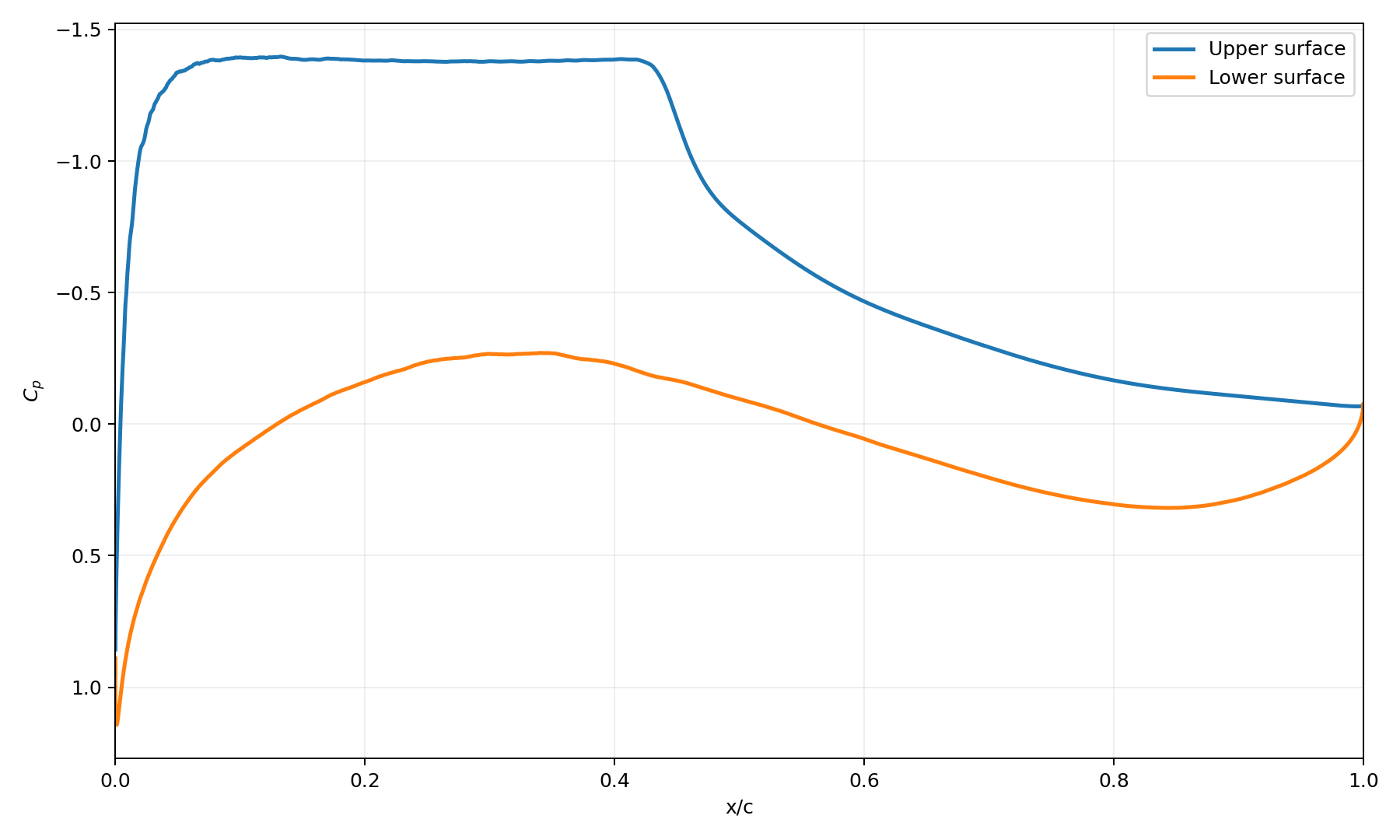
The ONERA OAT15A investigation uses time-resolved simulation and post-processing to examine pressure distributions, shock position and aerodynamic loads. Mesh comparisons and available experimental pressure data provide context for assessing the numerical behaviour.
- Pressure distributions
- Shock–load correlation
- Phase-resolved analysis
- Spectral and modal diagnostics
03 / ENGINEERING INSIGHT
Cycle-resolved analysis brings shock motion, separation and load response into a common view. This supports an assessment of the mechanisms behind the oscillation and of where a model requires further scrutiny.
RELEVANCE TO YOUR PROJECT
Assess unsteady aerodynamic loads
For a design affected by moving shocks or separated flow, mean lift and drag alone may not describe the loading. This research demonstrates how time-resolved pressures, shock position and force histories can be examined together.
- Compare pressure fluctuations and aerodynamic loads across selected operating conditions.
- Identify the frequencies and flow regions that deserve closer investigation.
- Assess what further numerical checks or measurements are needed before a design decision.
A project can be scoped around pressure distributions, force histories, dominant frequencies and comparisons between agreed configurations. The model fidelity and validation evidence must be assessed for your geometry and operating range.
STUDY SCOPE
An ongoing research investigation. Cross-code comparison and further numerical sensitivity work remain part of the study; the case is not presented as a completed industrial validation.