
When the flow changes the motion—and the motion changes the flow.
01 / THE QUESTION
How can unsteady flow and rigid-body response be assessed together in a controlled numerical comparison?
02 / THE APPROACH
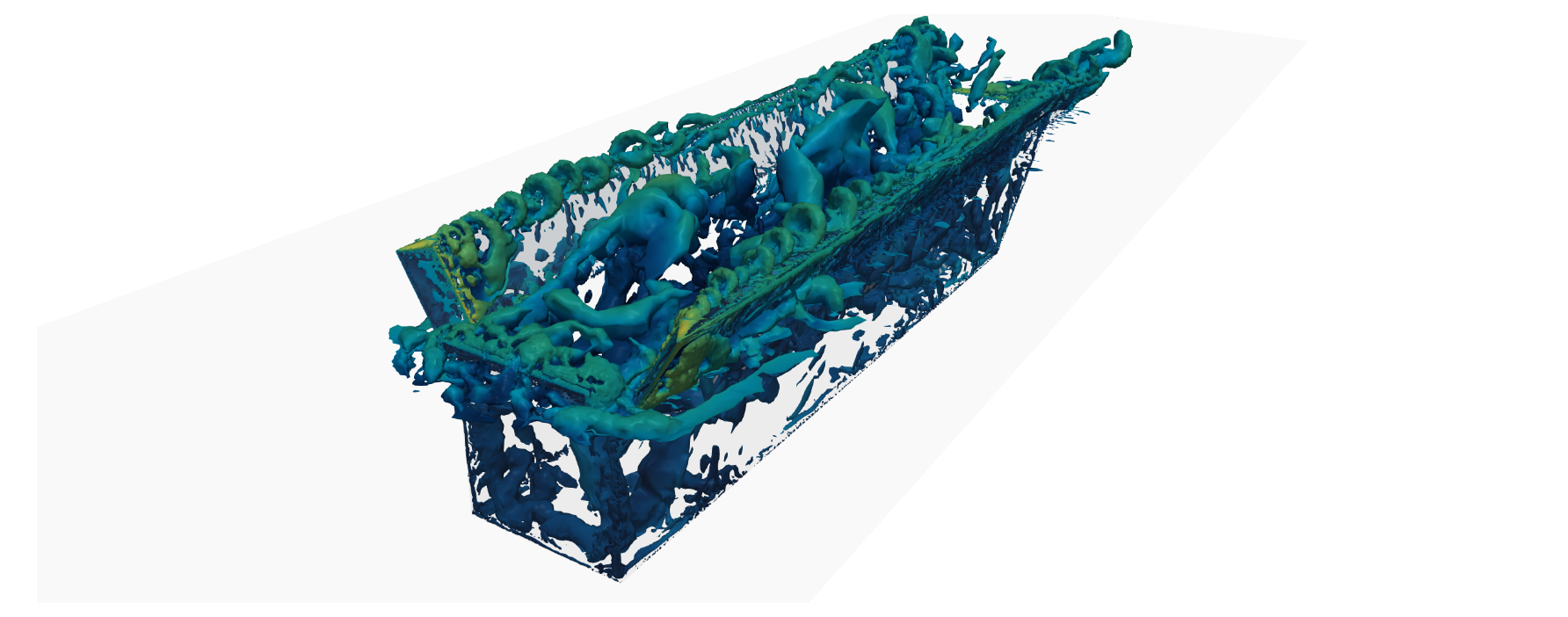
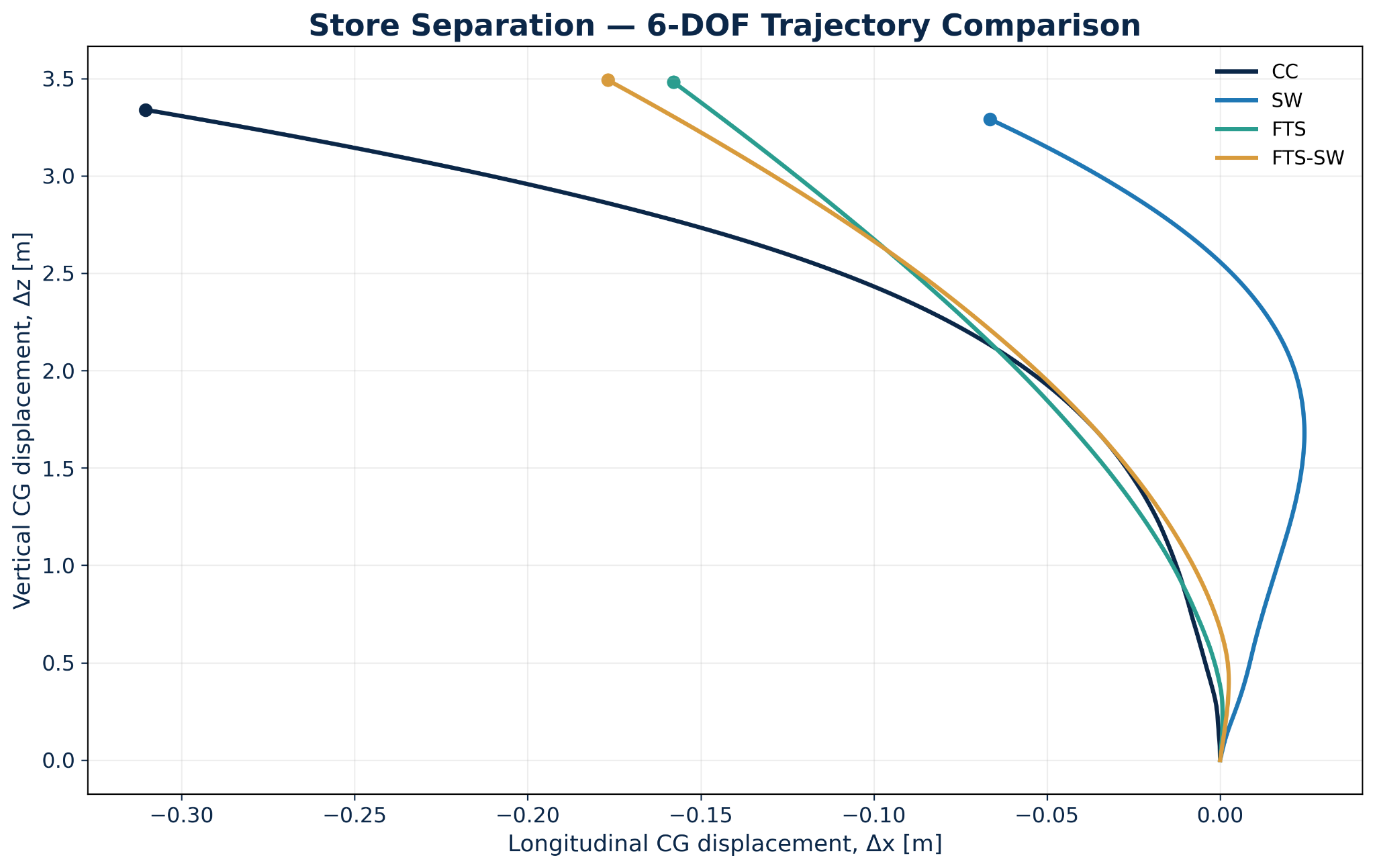
The research combines delayed detached-eddy simulation with six-degree-of-freedom rigid-body motion. A common numerical framework allows the relationship between flow behaviour, loads and body response to be examined across selected cavity configurations.
- Hybrid turbulence modelling
- Time-dependent loads
- Rigid-body response
- Comparative analysis
03 / ENGINEERING INSIGHT
Considering pressures, forces and motion together allows trade-offs that would be missed by examining a single flow metric. The emphasis is on interpreting the connected response within the investigated conditions.
RELEVANCE TO YOUR PROJECT
Analyse moving bodies and changing flow domains
Does your problem involve a moving boundary, a prescribed motion or a body whose motion is driven by fluid forces? We can scope dynamic CFD analyses using moving meshes and coupled six-degree-of-freedom (6-DoF) rigid-body motion. The store-separation study is one research example of this broader flow–motion capability.
- Assess how prescribed translation or rotation changes pressures, forces and moments.
- Investigate fluid-driven rigid-body motion, including trajectories, orientation and transient response.
- Compare geometries, motion constraints and operating conditions when the flow domain changes over time.
Depending on the agreed scope, outputs can include time-resolved flow fields, force and moment histories, body position and orientation, and comparisons between dynamic operating scenarios. We assess the mesh-motion strategy, motion constraints, mass and inertia where relevant, and numerical sensitivity for your application. Validation requirements are agreed for the specific problem.
STUDY SCOPE
A research example of coupled flow–motion analysis based on the internal-store separation study. Results are bounded by the investigated configuration and operating condition.
RELATED PUBLICATION
Numerical analysis of the impact of release timing on trajectory in internal store separation
S. Türk & K. M. Güleren
The Aeronautical Journal, 129(1335), 1361–1380 (2025).